
Soon, it will be Robert Burns’s birthday on 25 January. Scots all over the world will gather to celebrate his works. So who was Robert Burns and why does he still command such respect and admiration? In this blog, we will look at his life and works to help you better understand them.
So settle back, pour a wee nip of whisky (or your beverage of choice), and we’ll take a closer look at Scotland’s very own Bard.
Robert Burns Life Story
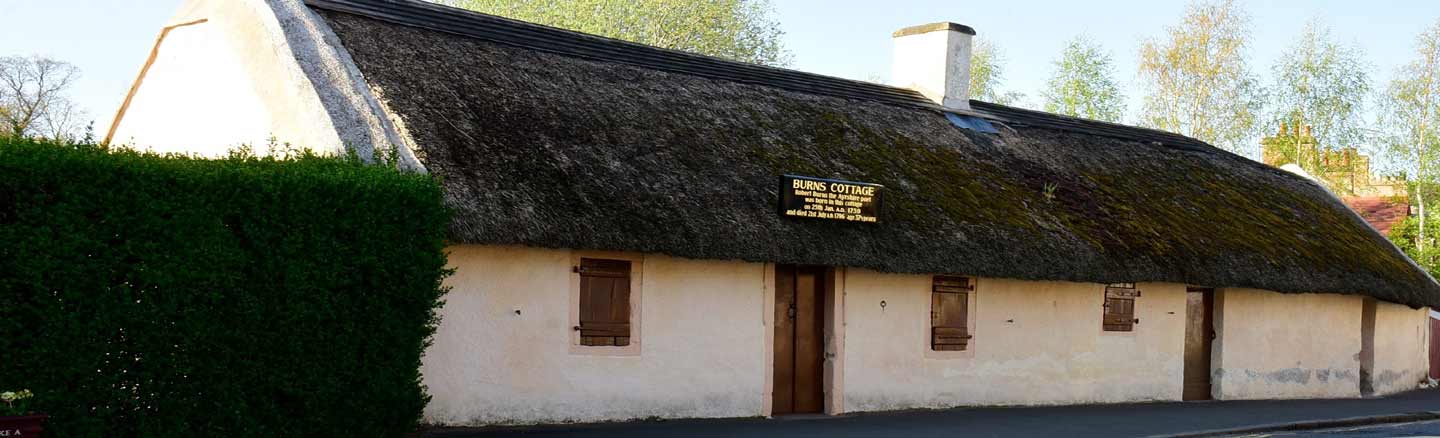
Robert Burns (often referred to as Rabbie Burns) was born on 25 January 1759 in Alloway, a small village in Ayrshire. His childhood was far from comfortable. His father, William Burnes, was a tenant farmer who worked hard but was struggling financially.
From an early age, Burns was a hard labourer, working long days in the fields, and facing the uncertainty of farming life in 18th-century Scotland.
Despite this, Burns received a surprisingly good education for a farmer’s son. His father believed strongly in learning and hired home tutors when he could. Burns grew up reading literature, learning grammar, and developing a deep love for language. That mix of hard labour and intellectual curiosity would shape everything he later wrote.
Man of the people
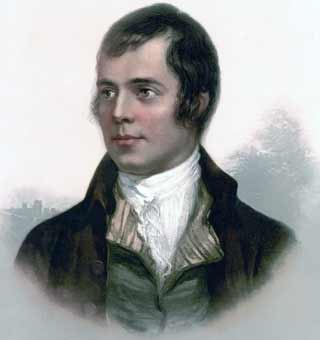
As a young man, Burns worked on various farms across Ayrshire. The work was backbreaking and often unrewarding, but it gave him endless material. He wrote about the lives of farmers, labourers and tradespeople not from a distance, but from experience. He knew their frustrations, humour, and quiet pride because they were his own
Burns also had a complicated personal life. As he got older, he cared less about farming and more about poetry, women, and drinking - all to his father’s great disappointment.
In 1785, he had an illegitimate child with a servant girl. A lady often associated with Burns was Jean Armour, who became pregnant the following year. He tried to marry her, but her father refused. Upset with this rejection, Burns planned to travel to Jamaica with another female companion, Mary Campbell, but unfortunately, she died a short time later. Campbell is often referred to as “Highland Mary” today.
The Ploughman’s Poet
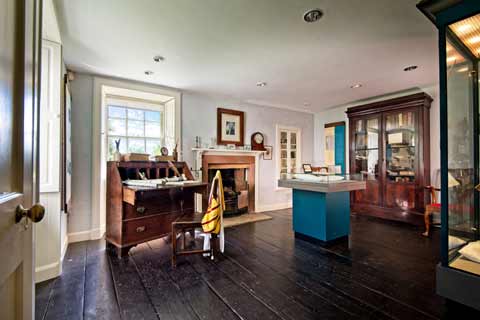
In 1786, Burns published his first major collection, “Poems, Chiefly in the Scottish Dialect”. It was an immediate success. Suddenly, the farmer from Ayrshire was famous. He travelled to Edinburgh, where he was welcomed into literary circles and celebrated as a natural genius. Yet fame didn’t bring financial security.
In 1788, Burns leased Ellisland Farm near Dumfries and married Jean Armour. Here, he had a double life. A hardworking tenant farmer and exciseman, as well as a flourishing poet who was a literary hero to the higher echelons of Scottish society. It’s thought he wrote a quarter of his work at Ellisland, including some of his finest and best-known pieces.
Burns died in 1796, aged just 37. Poor health, exhaustion, and years of hard living took their toll. His funeral was modest, but his reputation only grew after his death. What he left behind was a body of work that spoke to people far beyond his own time and place.
What Is Robert Burns Famous For?
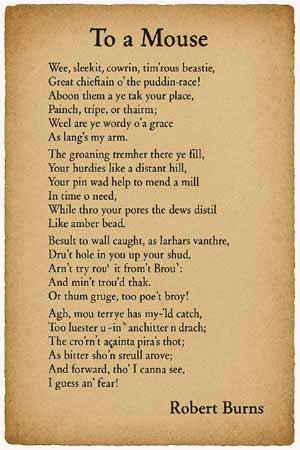
Burns is best known as Scotland’s national poet, but that title doesn’t fully explain his impact on our national life. His fame rests on a few key things: his use of Scots language, his focus on ordinary people, and his ability to write with warmth, humour and honesty.
One of Burns’ most significant achievements was proving that Scots could be a literary language. At a time when “proper” writing meant polished English, Burns wrote proudly in Scots. Poems like “To a Mouse”, “Tam O’Shanter” and “Address to a Haggis” used everyday speech to explore big ideas such as equality, kindness and human dignity. He showed that ordinary language could carry extraordinary meaning.
Politically, Burns was quietly radical. He believed strongly in equality and human rights, influenced by the ideals of the French and American revolutions. His famous line, “A man’s a man for a’ that,” remains one of the clearest statements of human equality ever written. He didn’t shout his politics, but he wove them into verse that was accessible and powerful.
Perhaps most importantly, Burns wrote with empathy. He cared deeply about people who were overlooked or dismissed. Farmers, soldiers, servants, animals, and women all appear in his work with dignity and depth.
Songs of Robert Burns
Burns also wrote some of the world’s most enduring songs. “Auld Lang Syne”, now sung at New Year celebrations across the globe, is his work. As are popular Scottish folk songs like “My Love Is Like a Red, Red Rose” and “Ae Fond Kiss”.
These aren’t dusty poems locked in books. They’re living songs, still sung, quoted and recorded today.
Rabbie Burns Day
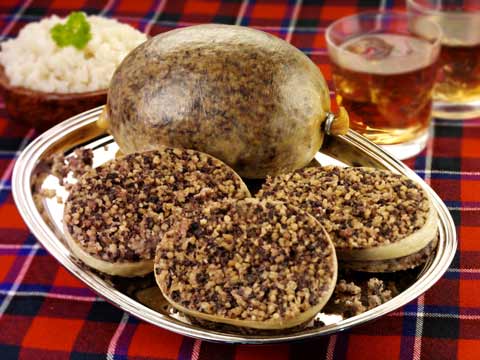
Every year on 25 January, Scotland celebrates Burns’ birthday with what’s known as Burns Night or Rabbie Burns Day. What began as a small gathering of friends has grown into an international tradition, with Burns Clubs meeting everywhere from village halls to embassies and cruise ships.
A traditional Burns Supper follows a familiar structure, though no two are ever quite the same. Guests gather for food, drink and poetry. The star of the evening is usually haggis, brought in with ceremony and addressed with Burns’ famous poem Address to a Haggis. There are speeches, toasts, laughter and often a fair bit of whisky.
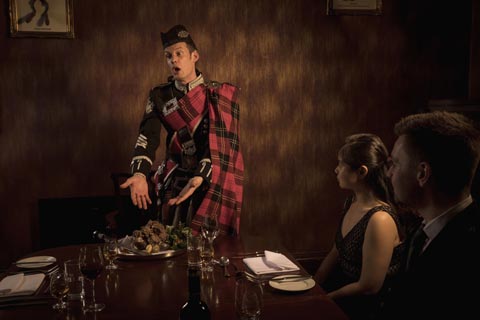
But Burns Night isn’t just about ritual. At its heart, it’s about connection. People read Burns’ poetry aloud, sing his songs, and reflect on themes that still matter: friendship, love, fairness and the passing of time. You don’t need to understand every word of Scots to feel the emotion behind it.
Burns Night is also remarkably flexible. Some suppers are formal affairs with kilts and speeches. Others are casual gatherings among friends. Some stick closely to tradition; others bend the rules entirely. Burns himself would probably approve. He wasn’t one for rigid formality.
What’s striking is how far Burns Night has travelled. From Scotland to Canada, Australia, the United States and beyond, people who may never have set foot in Scotland still gather to celebrate him. That global reach speaks volumes about the universality of his work.
Discover the best of Scotland with Scottish Tours
If you want to discover more about the country that inspired Robert Burns and a host of other writers, poets and musicians, why not join a tour with Scottish Tours?
Our great cities, stunning landscapes, rugged mountains and ancient castles are just waiting to be explored. Let Scottish Tours be your guide.
Explore our range of over 150 Scotland Tours and book today.
| TOUR TIP: Scottish and Irish Dream 13 Days/12 Nights from Glasgow |
Photo credits: Shutterstock and Robert Burns Ellisland Museum & Farm