
Honours of Scotland (Scottish Crown Jewels)
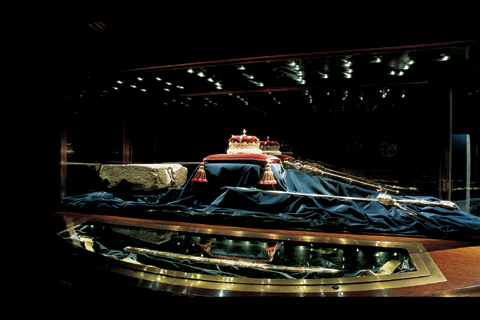
The Scottish Crown Jewels, known as the Honours of Scotland, are the oldest regalia in the British Isles. They comprise a crown, a sword and a sceptre, all of which date from the 15th and 16th centuries.
The Silver Sceptre
It is believed that the Silver Sceptre was a gift from Pope Alexander VI to King James IV in 1494. The Sword of State is another Papal gift, this time from Julius II, who commissioned Michelangelo to paint the Sistine Chapel.
The Crown of Scotland
The Crown of Scotland was made for King James V in 1540. It was refashioned from a damaged and lighter crown by an Edinburgh goldsmith. The Honours were first used as regalia in the Coronation of Mary, Queen of Scots, in 1543. She was a mere nine months old.
After the union of Scotland and England in 1707, the new United Kingdom Parliament sat in London, so the Honours were locked away in Edinburgh Castle. After a campaign by Sir Walter Scott, they were rediscovered in 1818, still in their protective linen covers, hidden in a chest.
These symbols of Scottish nationhood are on permanent public display in the Crown Room at Edinburgh Castle.
Stone of Destiny
Wrapped in legend, this ancient symbol of the Scottish monarchs has played a significant role in the inauguration of Scottish Kings for centuries. Experts believe that the stone was first used at the Coronation of Kenneth MacAlpin, in the Ninth Century.
In 1296, King Edward I of England captured the stone and had it taken to Westminster Abbey. It was placed underneath the wooden chair on which all subsequent English monarchs were crowned.
The stone returns to Scotland
On Christmas Day 1950, a group of Scottish students liberated the stone and returned it to Scotland. After a nationwide search, the stone was found on the altar of Arbroath Abbey and returned to London.
The British Government returned the Stone of Destiny to Scotland in 1996. The Stone of Destiny is on display at Perth Museum, but was returned to London for the Coronation of King Charles in 2023.
The Unicorn
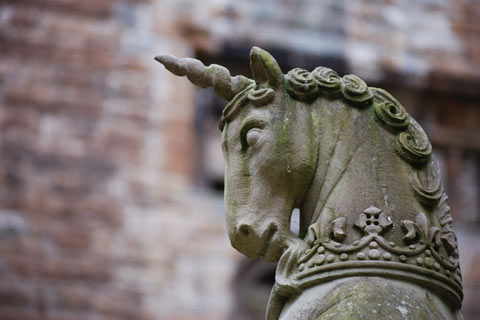
Scotland’s national animal is the unicorn, which, according to Celtic folklore, represented purity, innocence, supremacy, and power.
The mythical creature appeared on the Scottish Royal Coat of Arms in the 12th century. In 1603, King James VI of Scotland became King James I of England and Ireland.
To demonstrate that the countries were united, he replaced one of the unicorns with a lion, the national animal of England. As the unicorn is the strongest of all animals, it appeared on the crest in a chain to symbolise the power of the King.
The Kilt
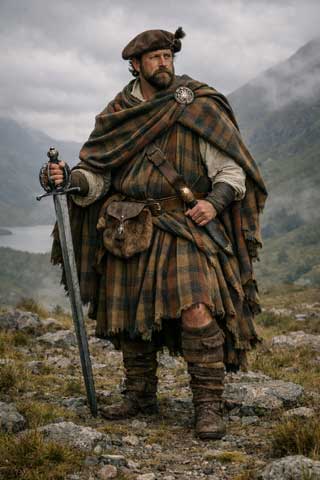
The original kilt (Feileadh Mor)
The feileadh mor (which means “Long Wrap” in Gaelic) was the predecessor of today’s kilt. It was a longer, untailored garment, around five metres in length, gathered and belted at the waist to provide cover for both the upper and lower body. From the waist down, the feileadh mor resembled a modern kilt, while the remaining material above the waist was draped over the shoulder and pinned there.
This upper portion can be arranged in various ways around the shoulders, depending on the weather, temperature, or the required freedom of movement. At the end of the day, the belt could be unbuckled to transform the feileadh mor into a warm night covering.
Evolution into the Feileadh Beag (Little Kilt)
The feileadh mor was simplified by disposing of its top half, leaving the belt and the skirt below. The resulting creation became known as the feileadh beg, or “little kilt”. This was reputedly at the behest of an Englishman running an ironworks at Invergarry who felt his kilted employees needed a greater freedom of movement to do their work.
Whatever the impetus for change, the kilt became a tailored garment with sewn-in pleats, making it neater and far easier to put on and wear. The upper half of the big kilt evolved into the separate plaid (or sash), which is now worn at more formal events.
Proscription after the 1746 Jacobite Rising
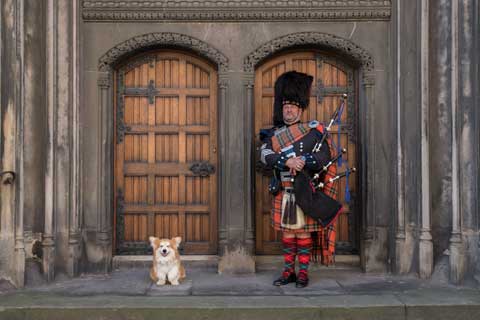
Following the Jacobite defeat at the Battle of Culloden in 1746, the kilt and other aspects of Highland dress were outlawed; however, their continued survival during these years was largely due to their adoption by Highland regiments serving in the British army.
Highland regiments still wear the kilt regularly (although no longer into battle), but for most people, it is not an everyday article of dress in Scotland.
The kilt in Modern Scotland
Modern kilts have up to eight metres of material, which is thickly pleated at the back and sides, with the pleats stitched together only at the waistband.
Visitors are more likely to see kilt-wearers at formal celebrations such as weddings and at Highland Games or similar gatherings. And although the kilt is typically regarded as being Highland dress, more kilts are now worn in the Lowland cities than in the Highlands.
Fashion designers have also attempted to update the kilt, making it more appealing to a broader audience by incorporating non-tartan designs, such as camouflage, and materials like leather or tweed.
The Thistle
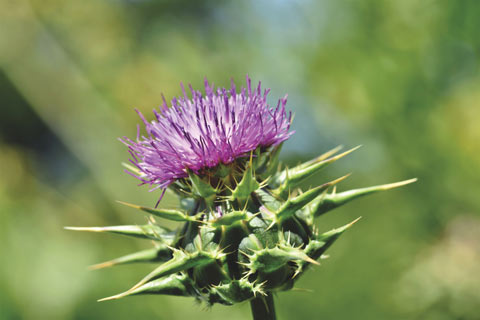
The legend of the Guardian Thistle
But why is it that such a proud people as the Scots should choose a humble weed as their national symbol? In truth, no one knows.
There is a legend that relates how a sleeping party of Scots warriors was almost set upon by an invading band of Vikings and was only saved when one of the attackers trod on a wild thistle barefoot. His cries raised the alarm, and the roused Scots duly defeated the Danes.
In gratitude, the plant became known as the Guardian thistle and was adopted as Scotland’s symbol.
Which thistle is the “Real” Symbol?
Sadly, there is no historical evidence to support the tale, and in fact, there’s even confusion about the type of thistle represented everywhere. There are many species of thistle, including the spear thistle, stemless thistle, cotton thistle, Our Lady’s thistle, musk thistle, and melancholy thistle, which have all been suggested as possible candidates.
The thistle in Scottish Heraldry
Whatever its origins, the thistle has been a significant Scottish symbol for over 500 years. Perhaps its first recognisable use was on silver coins issued in 1470 during the reign of James III, and from the early 16th century, it was incorporated into the Royal Arms of Scotland.
Scotland’s premier Order of Chivalry is The Most Ancient and Noble Order of the Thistle. It was established in 1687, and its members wear a collar chain whose links are made of golden thistles.
The Knights and Ladies of the Thistle also wear a breast star which bears the thistle emblem. The motto which is regularly associated with the Thistle is, Nemo Me Impune Lacessit - “no one provokes me with impunity”.
The Saltire – Scotland’s National Flag
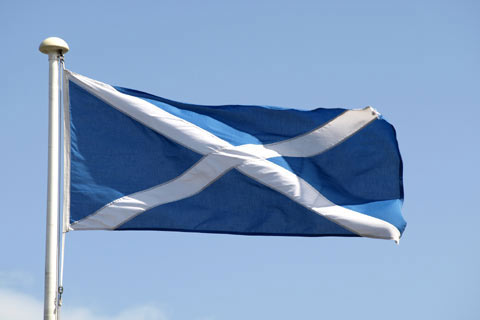
This flag is an integral part of Scotland’s unique identity. The Scottish flag or `saltire’ is derived from the cross of St Andrew, Scotland’s patron saint. Its adoption is said to date from a battle, some say in 756, between a combined Pictish and Scottish force and invading Northumbrians under their leader Athelstan.
King Angus I of Scots prayed to St Andrew, and a vision of the cross of St Andrew was seen, white against a blue sky. This helped the Scots to victory.
Where can you see the Saltire today
You will see the flag flying in plenty of locations throughout the country, as Scotland’s own symbol. It is usually flown over public buildings, but you’ll also see it most notably at Athelstaneford, near Haddington, East Lothian, the site of the ancient battle.
The cross is also part of the Union Flag, a symbol of the United Kingdom.
The Lion Rampant flag was chosen by William I of Scotland for his standard. It shows the red lion standing on its hind legs surrounded by a border of fleurs-de-lis.